
Treble Bleed Circuits Explained: What They Are and Why You’ll Want One by HGWFx

Have you ever rolled down your guitar’s volume knob only to notice the tone suddenly becoming dark, muddy, and lifeless? Many players use the volume control just for muting, but it can be a powerful tool for dialing in everything from sparkling cleans to rich overdrive. A treble bleed circuit fixes that common issue and keeps your tone balanced and vibrant at any volume.
Why Does Treble Disappear When You Turn Down the Volume?
When you lower the volume pot, you add resistance in series with the pickup’s signal. Combined with your guitar cable’s capacitance and the pickup’s own characteristics, this creates a low-pass filter. Lower frequencies pass through easily, while higher frequencies get attenuated. The result? A dull, muffled sound that many find unusable.

The Simple Fix: A Treble Bleed Circuit
A treble bleed is an easy, inexpensive modification. It typically consists of a small capacitor (sometimes paired with a resistor) wired in parallel across the volume pot’s input and output lugs. This lets high frequencies “bleed” through as you turn down the volume, preserving clarity and sparkle. You can install it yourself with basic soldering skills, or have a tech do it quickly and affordably.
Why Aren’t They Standard on Factory Guitars?
Many classic designs predate widespread awareness of the issue, and cost-saving played a role. Some manufacturers treat it as an aftermarket upsell. Fortunately, more builders (especially in Asia) now include them as standard. It’s a worthwhile upgrade for any passive guitar.
Common Treble Bleed Configurations
Here are the three most popular setups, each with pros and cons:
1. Single Capacitor
A lone capacitor across the volume pot’s lugs.
Pros: Simple and effective for many guitars.
Cons: Can make the tone overly bright or “tinny” at lower volumes.

2. Capacitor + Resistor in Parallel
A resistor wired alongside the capacitor to tame excessive highs.
Pros: Balances the signal well for most instruments.
Cons: Can slightly alter the volume pot’s taper.
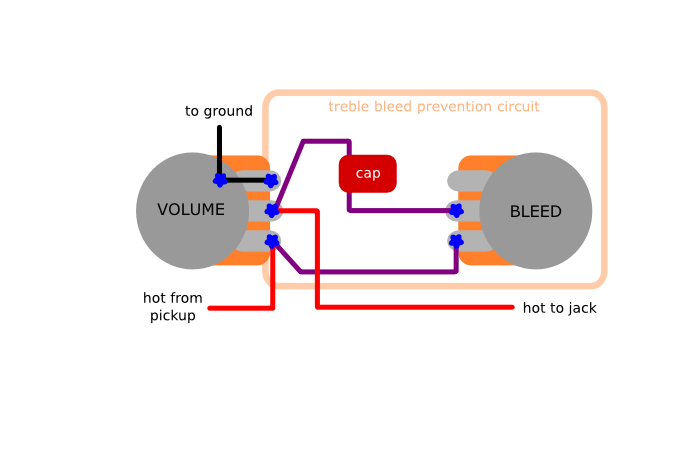
3. Capacitor + Resistor in Series (Kinman Style)
Popularized by Australian luthier Chris Kinman. Widely regarded as the most refined option.
Pros: Maintains natural volume taper and prevents tinny highs.
Cons: Component values need careful matching to your pickups.

Choosing Components
Capacitors: Use ceramic or film types (electrolytics are unsuitable). Common values range from 220 pF to 1500 pF; 1000 pF is a popular starting point. Smaller physical sizes fit best in control cavities.
Resistors: ¼-watt carbon film or metal film. Typical values: 100kΩ to 330kΩ. A 150kΩ resistor paired with a 1000 pF capacitor is a reliable “set it and forget it” combo recommended by many techs.

Experiment and Dial It In
Tone is personal, so testing different values helps. Solder temporary wires with alligator clips to the volume pot’s lugs and swap components until it feels right. The mod is fully reversible and won’t affect your sound at full volume.
Final Thoughts
A treble bleed circuit is one of the most useful, low-cost upgrades you can make to your guitar. It transforms the volume knob into a true tone tool without sacrificing highs. Passive guitars and basses benefit most—active electronics generally don’t need it.
If you’re in Stockton or the surrounding area and want professional installation, feel free to reach out to Hatch Guitar Works. We’d be happy to help your instrument sound its best.
Ready to try it? Your ears (and your audience) will thank you.
Written by Quincy Hatch, Hatch Guitar Works


Comments