
Understanding Effect Pedal Types: A Clear Guide for Guitarists

Effects pedals are the secret sauce that transforms your guitar tone from ordinary to extraordinary. Whether you're chasing warm cleans, roaring distortion, or lush atmospheric textures, understanding the main categories of pedals helps you build a pedalboard that inspires creativity and serves your music.
At Hatch Guitar Works, we've repaired, modded, and built countless pedals over the years. This guide breaks down the primary effect pedal types in an approachable way, with tips on how they work and where they shine.
1. Drive Pedals (Overdrive, Distortion, and Fuzz)
These are the workhorses of many rigs. Drive pedals push your signal into saturation, adding grit, sustain, and harmonic richness—perfect for everything from bluesy breakup to high-gain metal.
Overdrive: Mimics the natural breakup of a cranked tube amp. It's dynamic and responsive to your playing touch and guitar volume knob. Think smooth, singing leads and edge-of-breakup rhythm tones.
Distortion: More aggressive with tighter clipping and higher gain. Great for rock and heavier styles.
Fuzz: Extreme saturation with a thick, woolly character (often from germanium or silicon transistors). It can feel almost synth-like and pairs beautifully with single-coils.
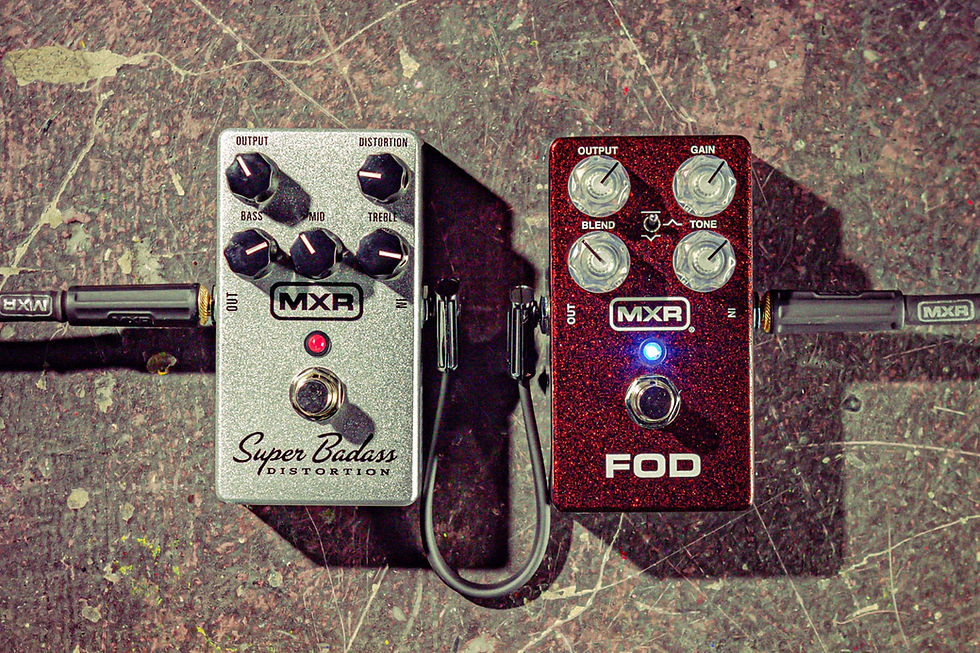
STACK 'EM UP: HOW TO COMBINE OVERDRIVE, DISTORTION, & FUZZ - Lifestyle - Dunlop Pro Tip: Stack them! A light overdrive into a higher-gain distortion can yield massive, musical tones.
2. Modulation Pedals (Chorus, Flanger, Phaser, Tremolo, Vibrato)
Modulation effects add movement and depth by varying your signal's pitch, volume, or phase over time. They create that "swirling" or "shimmering" feel heard on countless classic records.
Chorus: Duplicates your signal with slight pitch and delay variations for a rich, ensemble-like sound.
Flanger: Similar to chorus but with a more dramatic, jet-like whoosh from shorter delay times and feedback.
Phaser: Uses phase shifting to create notches in the frequency spectrum for a sweeping, psychedelic effect.
Tremolo & Vibrato: Tremolo pulses volume; vibrato wobbles pitch.

3. Time-Based Effects (Delay and Reverb)
These pedals add space and dimension, simulating echoes or room acoustics.
Delay: Repeats your signal at set intervals. Analog delays warm up and degrade naturally; digital ones offer pristine repeats and tap tempo.
Reverb: Creates ambient tails and reflections. Spring reverb has a vintage splash, while hall/plate types feel more spacious.
Place these near the end of your chain so they process everything upstream.
4. Dynamic and Filter Effects (Compressor, EQ, Wah)
These shape your core tone and dynamics.
Compressor: Evens out volume peaks for sustain and punch—ideal for chicken-pickin' or clean tones that cut through a mix.
EQ: Boosts or cuts frequencies for tonal sculpting or problem-solving.
Wah: A foot-controlled filter that sweeps frequencies for expressive "talking" guitar sounds.

Typical Signal Chain Order (flexible, but a solid starting point):
Tuner → Compressor → Drive (OD/Dist/Fuzz) → Modulation → Delay → Reverb
5. Utility Pedals (Volume, Boost, Looper, etc.)
Don't overlook these—they make your board more playable. A clean boost can push your amp into natural overdrive, while a volume pedal doubles as an expression tool.
Building Your Pedalboard
Start simple: One drive, one modulation, and one time-based pedal. Experiment relentlessly—there's no "wrong" way if it sounds good to you. At Hatch Guitar Works and HGWFx, we specialize in pedal repairs, mods (like our ProCo RAT and Tube Screamer updates), and custom builds that help players dial in their perfect tone.
Ready to level up your rig? Drop by our shop in Modesto or check out our HGWFx pedals. What’s your favorite effect type or pedal? Share in the comments—we love talking tone!
Written by Quincy Hatch, Hatch Guitar Works


Comments